GÖD, Emergence, Life

Can an omnipotent God create a task he is unable to complete? Is perception limited, if only temporarily, with a growing infinite? Does my creator pose the same questions to his creator as I pose to him? Does my creator’s creator pose the same questions to his creator?…
break;
The Incompleteness Theorems are applications of logic which extend beyond mathematics. The theorems state that any system of logic cannot deductively prove itself to be true; i.e., there must be at least 1 axiom that is inductively reasoned through observation and cannot be deductively confirmed. For example, cavemen could take into account gravity’s effects when hunting, but precisely quantifying gravitational forces did not occur until Newton’s discoveries. It took over 200 years more for Einstein’s general relativity to expand the application of gravitational laws to a broader set of cases. Today, scientists hypothesize on how these forces exist and are in search of the graviton and Higgs boson elementary particles. Although the effects of these particles are detected and included into the Standard Model, they have yet to be “seen”. If/when these particles are found, more questions would present themselves, in accordance with the Incompleteness Theorems. Where did these forces come from? What sub-elementary particles make up the elementary particles? What sub-sub particles make up those?…
break;

Despite being able to make millions of calculations/sec, artificial intelligence still lags behind human cognition. The distinction surely lies with consciousness, or the awareness of being aware. Without consciousness, a futuristic computer would
not be able to look at its own processes and see the futility of the endeavor. Could
“breaking out of the loop” be the key to emergence of complex systems out of simpler parts? How does consciousness emerge out of neurons, and neurons out of cells, and cells out of atoms, and…
break;
There seems to be an infinite number of microscopic subatomic particles, forces, and events that must converge at an unconscious level for the improbability of consciousness to arise. Benjamin Libet’s experiments demonstrate that electrodes are able to detect brain activity which can predict my preference for Justin Bieber over Lady Gaga (among other less important things) up to 10 seconds before I am aware of my own choice. If the interactions between neurons occur many moments before I feel these neurotransmitters, is free will an illusion? It appears that the brain is aware of itself after neurons have been fired, just as neurons would be aware of themselves after cells have interacted, and…
break;

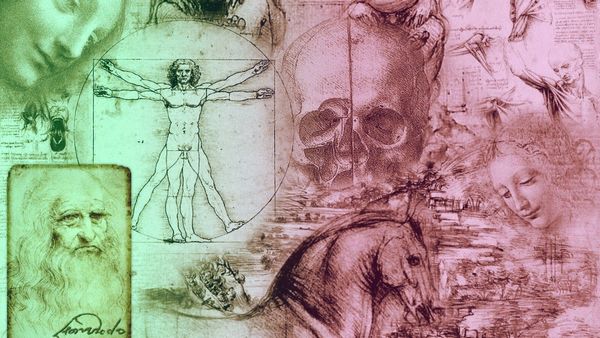
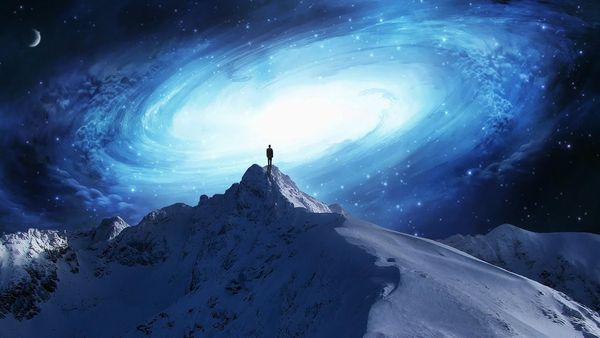
In a future with vastly superior computers that can handle and answer any question thrown at them, what would I do? Do I continue to find a brighter light to shine into the void like a program calculating pi? Or do I look into the darkness and create beauty and meaning through art? Or do I follow the Zen path by observing the absurdity of these infinite loops and paradoxes from outside this system? Or do I…
return 0;


Martijn Schirp said on 02.28.2012
Amazing infographic, I really like it. Clear explanation of Gödels theorem aswell! I personally also like Turing’s variation on it
He proved that some such machine would be capable of performing any conceivable mathematical computation if it were representable as an algorithm. He went on to prove that there was no solution to the Entscheidungsproblem by first showing that the halting problem for Turing machines is undecidable: in general, it is not possible to decide algorithmically, whether a given Turing machine will ever halt. (from wikipedia, I was a tad lazy)
Looking forward to read more by you!
Russelldinho said on 02.28.2012
Thanks Martijn! That’s about the extent of my creativity outside of humorous writing, so I doubt I can contribute something the community would value :(
Alex said on 02.28.2012
THANK YOU! Godels Incompleteness Theorems are not talked about hardly enough!
Russelldinho said on 02.28.2012
Agreed, it’s an extremely undervalued theorem that very few people know about. I actually decided to write about it when my search on this site came up blank.
Megan Wilson said on 02.28.2012
For someone who’s never heard about Godels Incompleteness Theorems before today, this was awesome! Reminds me a bit of the principles behind the mobius strip. I will have to do some more research after I get my thesis chapter written today. Thanks for posting this!
Russelldinho said on 02.28.2012
Thanks Megan. One of my goals was trying to express an abstract concept very simply to a large number of people who had never heard of this before. I feel like most people don’t understand the true essence of the Theorems.
vishnu said on 02.28.2012
well, you’ve done exactly that, Russell, i had never heard of these theorems too.. and i didnt even notice they were Theorems until you mentioned it up there. excellent! simplicity is a hard thing to find nowadays…
Russelldinho said on 02.29.2012
Thanks vishnu, did you notice that GÖD, Emergence, Life = GODEL
Josh said on 02.29.2012
I remember our AP Physics teacher trying to correlate this to some of the brighter kids in our school and fairly much no one grasping the concept, except myself and the validictorian, however, we both had to research the concept further to even get an elementary understanding. Our teacher was not suited to be teaching high school’s most challenging course. Thanks for the easy to understand explination!
Russelldinho said on 02.29.2012
Thanks Josh. You are lucky to have had a class that even mentioned it. My AP Physics teacher probably had never heard of it, and even if he did, he probably wouldn’t have understood it haha.
Jon Leo said on 07.31.2012
HOW CAN YOU LIKE JUSTIN BIEBER MORE THAN LADY GAGA???
chloe said on 08.01.2012
I can’t even comprehend this article…
Darin Cessario said on 08.08.2012
I love me some theorem. :-)
Kris said on 08.27.2012
Yes, go the path of Zen, observe, ponder and marvel at these quandaries, but don’t be dismayed by them! :-)
Life is great!
And consciousness is way greater than the sum of its apparent parts.
The brain is a filter through which our consciousness lives, experiences, expresses itself , etc, while in the physical.
Once out of the physical we will say “Aha, oh yes, I get it now.”
Jaz said on 09.17.2012
I enjoy your question “is free will an illusion?” I’ve wondered the same thing. Because you can’t change how you actually feel about say, Justin Bieber. I’ve never liked him and never will. But what if I wanted to? What if I wanted to “be like all my friends”? It’s nothing I could decidedly change just by changing my outlook on him. I loathe his music & the persona he gives off in the media. Even if I listened to him enough to get used to his songs, and tried my hardest to be a fan, it’d most likely be a waste of time.
It also ties in to my wonder of how generations enjoy the “hip” things of their time. Like you’ll rarely see anyone of our generation driving around bumpin big band music in their car. And yeah, one could argue that people like new and innovative things, but there’s so much big band music out there that I’m sure it’d take someone years to get tired of it. But it seems our generation has little interest in such popular things of long ago. And again, I’m not saying everyone, just most people.
Razique said on 09.21.2012
Excellent article, that just put a light on my day Russelldinho
Kendall Searle said on 12.05.2012
Get high, listen to Ratatat and relax…Life
zengod said on 02.19.2013
The only thing decided in this universe is the fact that there will always be at least one thing which is undecidable. The truth is there is no truth. I see that as neither a good thing nor a bad thing. Just simply peanut butter.
Human Purpose said on 02.24.2013
“The distinction surely lies with consciousness, or the awareness of being aware. Without consciousness, a futuristic computer would not be able to look at its own processes and see the futility of the endeavor.”
In my website http://humanpurpose.org I deal a lot with conscioussness and if conscioussness can arise from matter or not.
rudy gazudapek said on 04.07.2013
I like to boil things down. In my mind, it basically ends-up being a hardware/software question. The “how” a brain works is hardware, the “why” a brain works is software. Artificial intelligence, or better said, super computing operated with a life-like software program is a long way off, simply because of physics. The particles, and what makes up a particle, and what makes up the things that make up particles, and what makes up….well…shelving that nesting doll, the idea is that to replicate a biological system would have to include knowledge, and understanding of the whole picture, which we don’t possess at this time. Replicating the human brain will prove to be quite an undertaking indeed. With ~100 billion neurons communicating information through ~100 trillion synapses, all operating at distances that we are unable to replicate with current manufacturing techniques (optics allowing smaller resolved images usually pace the semi conductor industry) means the brain, as a computer, is still the fastest computing device (hardware) we’re aware of. Back in the late 80′s, early 90′s, it was easy for the industry to snicker at Seymour Cray when he spoke about the next big step in supercomputing being biologic circuitry. So aside from the fact that we are a loooong way off from producing a comparable computer as a human brain, we must also understand we’re even farther away from developing software for that computer. Replicating the why will be so much tougher than the how. Getting a head start on the “why” will possibly coincide with the “how” at some far off time. I think the biggest step is not to follow in footsteps as many students want to do (I see you groupies) but to lift yourself on their shoulders and point a new direction.
I, for one, suggest the Zen approach if this is the end game. Mostly because I have no desire in seeing a computer replicating a human brain. I think technology has plateaued in making us better life forms, and simply assists us in living a more convenient life (insert all the smart phone-twitter idiocies here). Yes this internet deal I am writing on helps us share ideas, and that’s about as good as it will ever get, as good as it should ever get. The more emphasis we place on devices living life for us, the less beautiful this life will become.